Categories
Uncategorized

Stefan’s Law

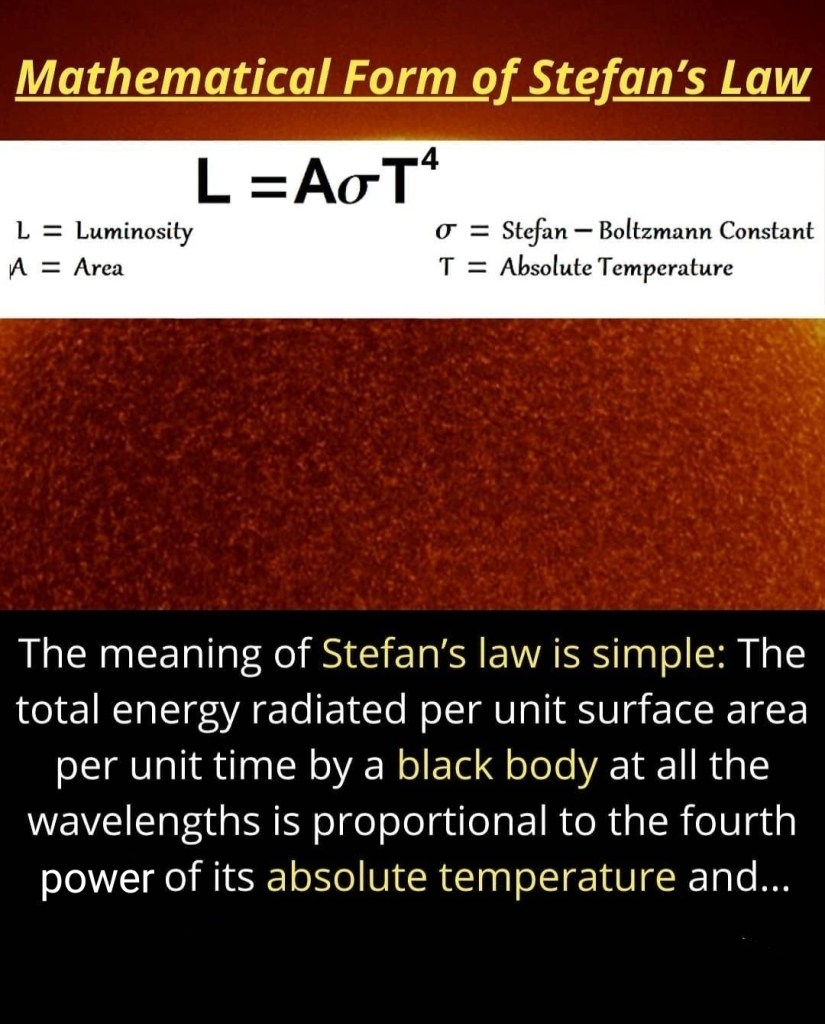
The Stefan–Boltzmann law, also known as Stefan’s law, states that the total energy radiated per unit surface area of a black body in unit time 
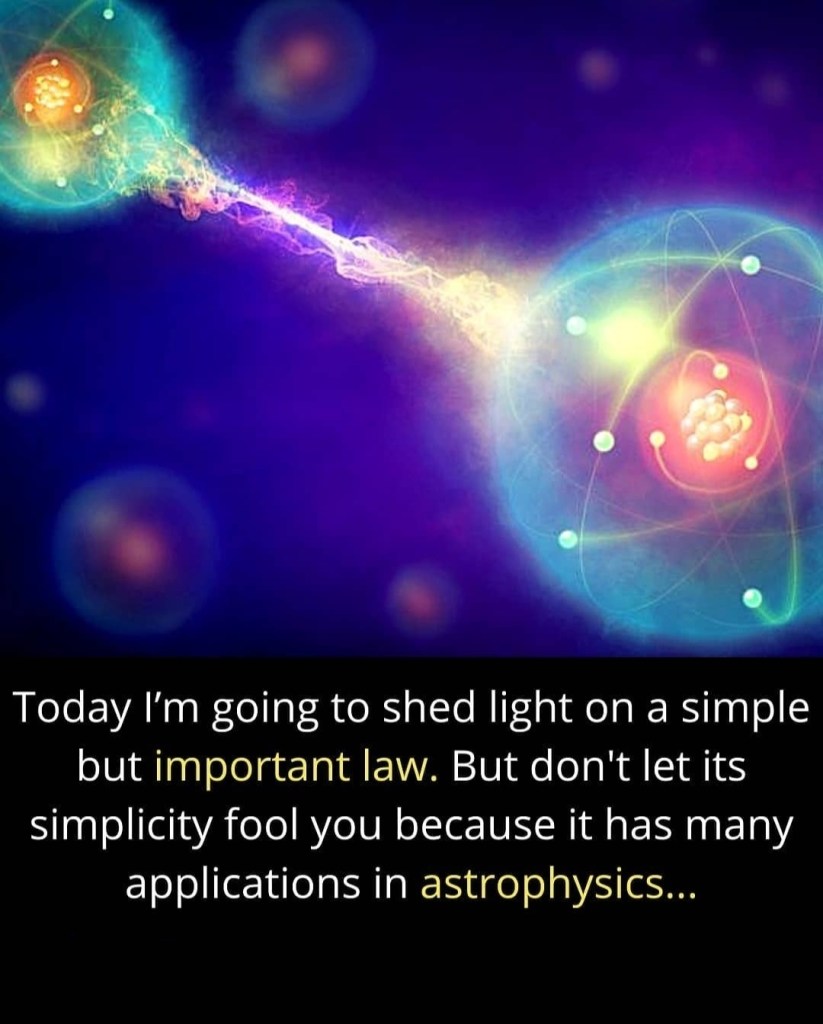
The Stefan–Boltzmann law, also known as Stefan’s law, states that the total energy radiated per unit surface area of a black body in unit time (known variously as the black-body irradiance, energy flux density, radiant flux, or the emissive power), j*, is directly proportional to the fourth power of the black body’s thermodynamic temperature T (also called absolute temperature):
Categories
Uncategorized

End of time

The future landscape of our universe depends, in large part, on the answer to a question regarding a subatomic particle.

Does the proton decay? Our standard model of particle physics says that it shouldn’t, but the only information we’ve been able to gain from laboratory experiments is that we haven’t been around long enough to answer the question.

If the proton does decay then it will take 10³⁴ years to have a chance of doing so. Not long after- in the grand timescale of the universe all other protons will also disappear, taking with them the ability to form planets, asteroids, black dwarf stars, and typical atoms.

What’s left will be a faint beading of weakly interacting particles like the rapid-moving neutrinos, the electron-positron couples, or the gamma-ray photons cruising listlessly in a dark, black hole dominated plain. Loved this post?

Information:The 5 ages of the Universe (book)
Design a site like this with WordPress.com
Get started